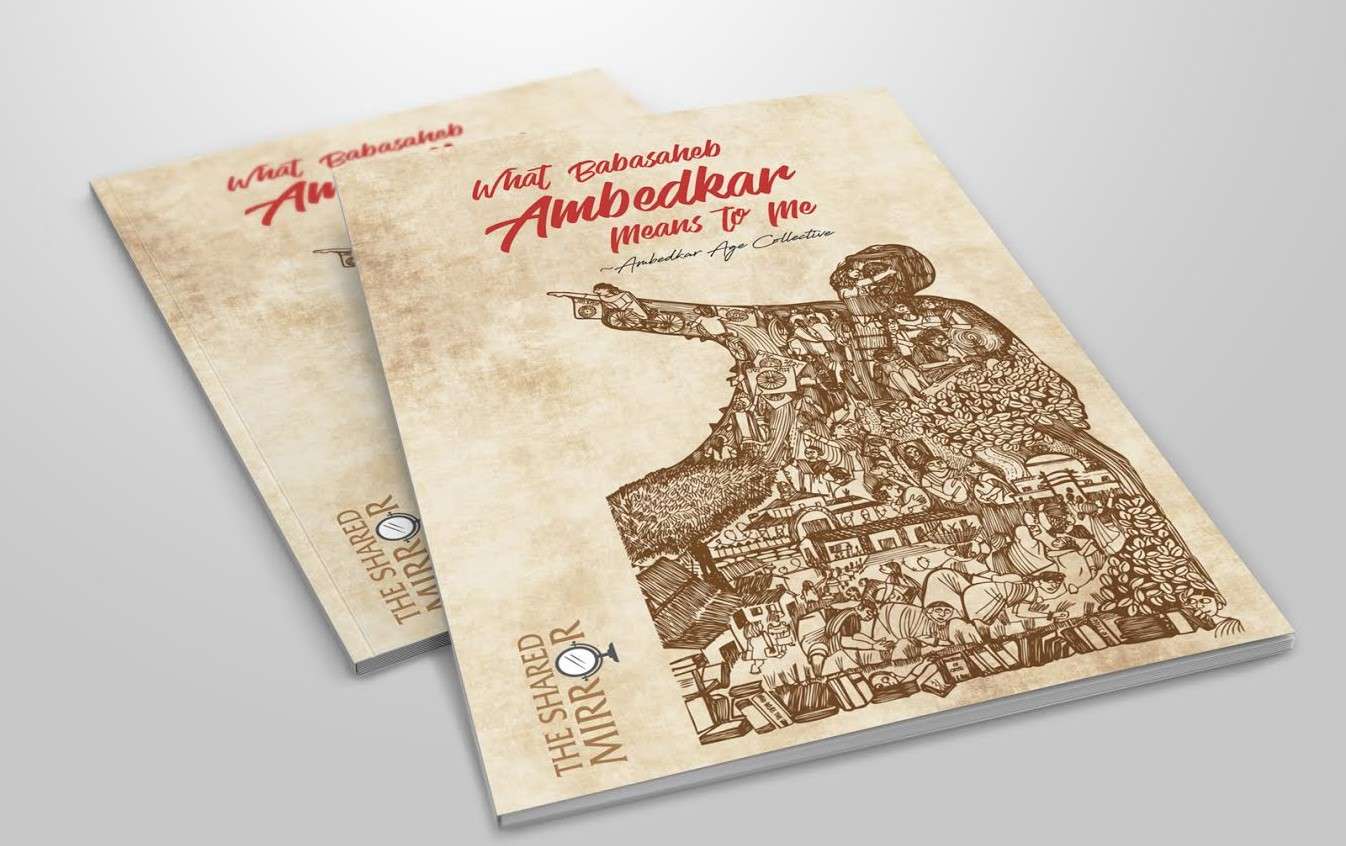
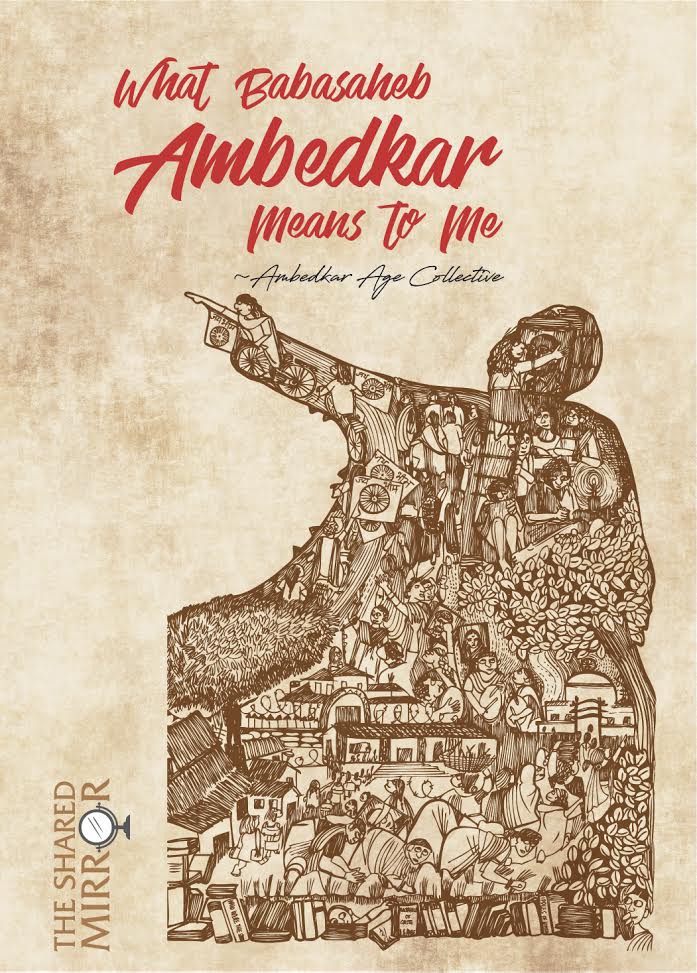
Book Release: What Babasaheb Ambedkar Means to Me

We are happy to announce the release of our new ebook What Babasaheb Ambedkar Means to Me commemorating the 125th birth anniversary of Babasaheb Ambedkar. The book can be freely downloaded.

To download this ebook, please click the Blue button on top.

Follow with checkout instructions for direct downloads.

An email will also be sent with the file. Enjoy Reading!


babasaheb_bookcover_1 Read more

Our New Title: What Babasaheb Ambedkar Means to Me

Jai Bhim! As we enter the 126th birth year of Babasaheb Ambedkar, The Shared Mirror is honoured to publish a compilation of essays on the theme ‘What Babasaheb Ambedkar Means To Me’ as a freely downloadable e-book, to be made available very soon!

For updates please follow our Facebook page!
https://www.facebook.com/WhatBabasahebMeans/?pnref=story
babasaheb_book_cover_rust

Celebrating Babasaheb’s life and achievements needs no particular occasion, he has emerged as a consciousness, a moral anchor for the masses. A musical tradition of rendering his life events from birth onwards, winding through Mahad, Poona Pact, Kalaram Mandir, Round Table conferences, the constitution itself, the conversion and his death was the foremost in the archiving of Babasaheb’s memory and multiple legacies. This people’s music in turn inspired artists, painters, writers and sculptors resulting in a vibrant visual rendering by people historians–men, women, young and old, who weave a tapestry of universal values of justice, equality, liberty and fraternity.
In a society that excludes at every turn, the excluded have claimed the public sphere with the physical shape of a bust or statue of Babasaheb. Can we even begin to fathom the processes that lead to seeing this physical manifestation of Babasaheb’s consciousness at narrow street corners and busy market places

On his 125th birth anniversary, in the act of remembering Babasaheb Ambedkar, The Shared Mirror invited young writers to send in articles on the theme of ‘What Babasaheb Ambedkar Means to Me’.

How do we embrace our roles in annihilating caste to create the foundation of a humane society? How do we celebrate his legacy and join his followers as workers laboring for an equal world?

The collection of essays in this book captures the writers’ thinking on visions for a better and just world through their engagement with Babasaheb Ambedkar. As an eminent writer, thinker, statesman and a formidable symbol of resistance, he occupies a position of highest integrity. It is a book that will make readers think along with the writers: Is Ambedkar an idea or an ideal? Is he a path or a journey? The readers get to engage in the dynamic process of viewing personal struggles alongside a benchmark of lofty human values, seen and understood through his incorruptible persona in life, words and accomplishments.

~~~

Manchester event: Discussion on ‘Hatred in the Belly: Politics behind the appropriation of Dr Ambedkar’s writings’

Manchester Launch of Hatred in the Belly: Politics behind the appropriation of Dr. Ambedkar’s writings
by  Ambedkar Age Collective
When: 6 – 8 pm, 6th October 2016
Where: Samuel Alexander A201,
The University of Manchester,
Oxford Rd, Manchester

Talks, Readings and Discussion
Chair: Rubina Jasani
Speakers: Anu Ramdas, Kuffir Nalgundwar, Gaurav Somwanshi, Sruthi Herbert, Sridhar Gowda, Kavita Bhanot


at-press2

midland-books-mr-mirza-afsar-baig


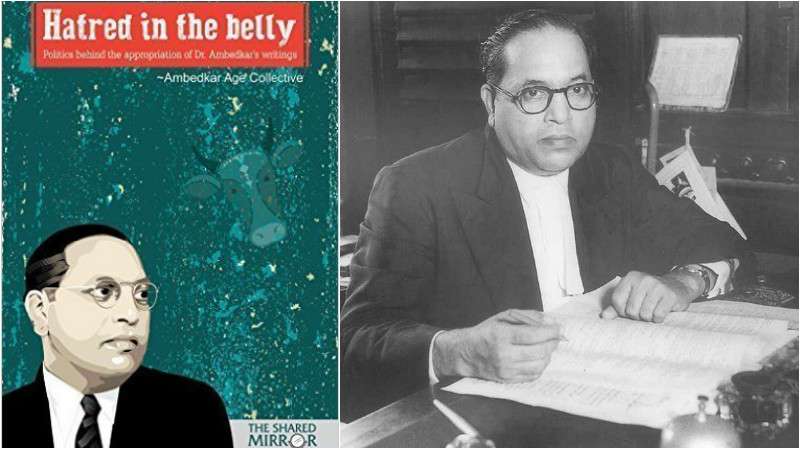
Hatred in the Belly published by The Shared Mirror is the powerful response by a number of Dalit-Bahujan writers to Arundhati Roy’s ‘much-needed-introduction’ to Ambedkar’s Annihilation of Caste, published by Navayana Press in 2014, and by Verso Press in the UK. While focussing on Arundhati Roy-Navayana’s project as a ‘case study’ of sorts, the book is an important and timely intervention that unpacks the wider politics

of the appropriation of Ambedkar and Ambedkar ‘s writings by brahmin/upper caste ‘progressives’. One of the important books of the 21st century, Hatred in the Belly raises important questions of representation, self-assertion and the damaging effects of an elite left and celebrity activism upon people’s movements and struggles.

hitb_dec6_2015

The book and the discussion around it brings layers and complexity to decolonial discourse in Britain, addressing structures and hegemonies of media, publication and academic discourse within India and how this plays out globally through international collaborations between ‘progressive’ elites. The book is also remarkable for the ways in which, bypassing powerful publishing, marketing and distribution structures and networks, it has emerged from a collective process of writing, editing, translating, publishing, marketing and distribution. We will be joined, via skype, by Gaurav Somwanshi, contributor to Round Table India and Hatred in the Belly, and Anu Ramdas and Kuffir Nalgundwar, founders/editors of Round Table India and editors of Hatred in the Belly. Join us for a discussion about the book, with an opportunity to buy a copy.

https://www.facebook.com/events/626718814158405/

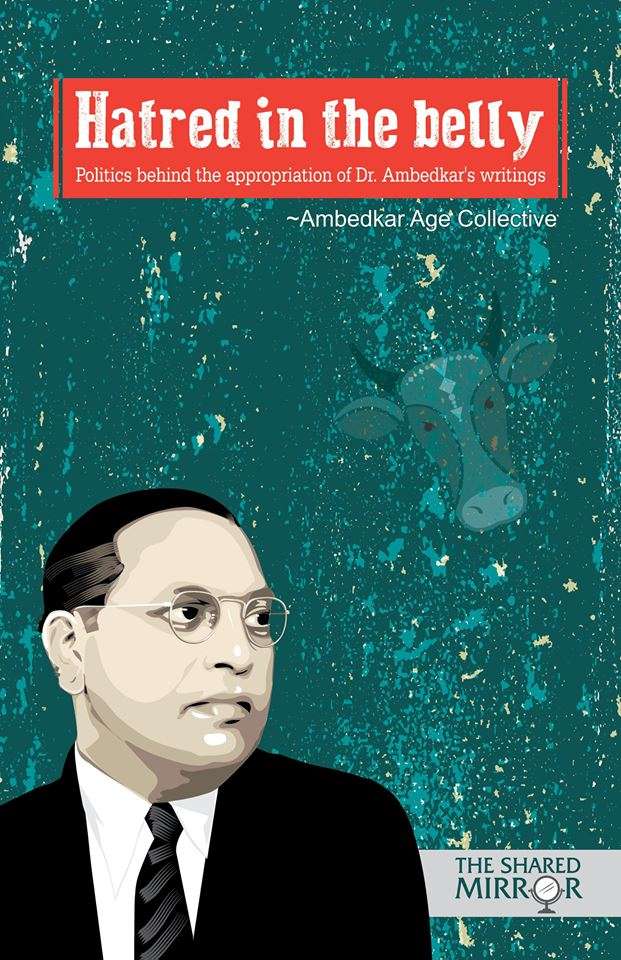
book cover hib


Not a Review but a Request: Read This Book — Hatred in the Belly

(Book Review Published on Feminisminindia)

By Unmana:

Hatred in the Belly book review

Annihiliation of Caste is Dr. B R Ambedkar’s seminal work, a rigorous, thoughtful critique of Hinduism that should be made a mandatory reading in India. What’s wrong then, with this spanking new edition, published by Navayana, with a long introduction by the brilliant Arundhati Roy?

The pieces in this book break that down. The title of this book, Hatred in the Belly, derives from a speech by poet Joopaka Subhadra, translated from Telugu, and referring to upper-caste feelings towards Dalits. The book is a compilation of essays and lectures, Facebook rants and cartoons that express discomfort with the idea of an ‘upper-caste interpretation’ of a piece that has been crucial to the Dalit rights movement.

This book is an education, especially for those like me who are vaguely anti-caste but have never done the hard work of learning and understanding. It explains exactly why this edition of Annihilation of Caste published by Navayana is appropriation; appropriation of the leader, the prophet of the anti-caste movement and packaging of his words for marketing to an ignorant, privileged audience. (Including me: I bought the Navayana edition as soon as I read the excerpt of Roy’s Introduction in the Caravan.) It demonstrates how the audience, the reception this book automatically got because of Roy’s writing is ironical given the lack of visibility given to Dalit writers, even to Ambedkar. It illustrates just how narrow, how privileged the lens of the liberal elite in India is, and how we perpetuate the same cycles of violence seen across the world, with the white saviour, or in this case the privileged upper-caste saviour, stepping in as the champion of the people who are being oppressed by the privileged ones.

Roy had said, much earlier, that she is not the ‘voice of the voiceless’, and that “there’s really no such thing as the ‘voiceless’. There are only the deliberately silenced, or the preferably unheard.” Dalits are very much the latter, and Gaurav Somwanshi’s essay The battle against caste is not just some ideology, it’s our existence explains just how hard it is to get texts by Dalit authors into non-Dalit spaces — publishing houses and bookstores and by extension, homes, let alone schools and libraries.

Given the severe marginalisation of Dalit voices and the systemic violence meted out to them, having Roy introduce the text instead of a Dalit scholar — or even a non-Dalit scholar — with a more nuanced understanding and deeper study of the issues would have made more sense. This feels like more of the ‘deliberate silencing’, especially when Roy’s introduction is as much about Gandhi as about Ambedkar, and very little about Annihilation of Caste itself.

It seems important to explode the myth of the Mahatma. But that exploration/explosion should be separate, and using AoC as the vehicle seems opportunistic, or lazy. Ambedkar’s arguments were against Hinduism, against caste, and the setting up of a supposed feud between ‘The Doctor and the Saint‘ (the title of Roy’s introduction) detract from the significance of Ambedkar’s text.

This text indicts all of us who aren’t Dalit, who would buy Navayana’s book but haven’t read much of Ambedkar’s works otherwise, who need globally renowned writer Arundhati Roy to introduce us to the man who had the most interesting, radical things to say about religion and equality in India much before anyone else.

Featured Image Credit: Cover image of the book Hatred in the Belly

Hatred in the Belly – A Book Review

(Book Review Published on Nirmukta)

By Anish Nair:

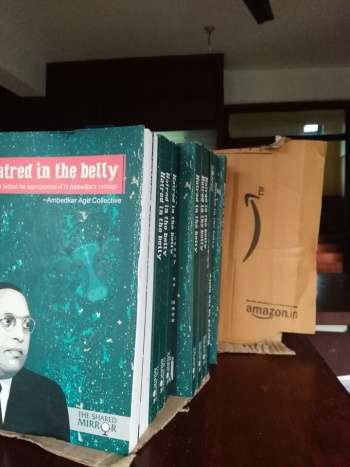
It has been over a month since the book ‘Hatred in the Belly: Politics behind the Appropriation of Dr. Ambedkar’s Writings’ was released by the Shared Mirror Publishing House. It is the work of a collective of 38 contributors, consisting of artists, poets, writers, activists, academics and anti-caste groups (like Round Table India, Savari, Dalit Camera, etc.), called the Ambedkar Age Collective. By the end of the first week of its release, it was a bestseller on Amazon and there was already a waiting list for booked copies. If you moved among the social justice circles, secularist and the Left of the Indian social media, the build-up to the release was very hard to miss, something attested by the fact that on the day of the release the hashtag #HatredintheBelly was quite prominent. The book’s release, in short, was phenomenal.

Yet, the entire literary and academic clique of the country somehow missed all of it. As I said, it has been over a month, but not even a passing mention of the book has come anywhere on the English-language press. Not one review. Over the years, I have read reviews about some of the most obscure writers and newcomers in national newspapers, journals and news websites, but this book just did not make the cut. And this is precisely the ‘Hatred’ the book deals with.

book cover hib

Amazon link for the Book

More than just Navayana’s AoC

In the year 2014, the publishing house Navayana released the book ‘Annihilation of Caste: the Annotated Critical Edition’. What Navayana essentially did was to convert a 50 to 60 pages long Annihilation of Caste (AoC) by Dr. Ambedkar to 400+ pages long book, half of which was an “introduction” by Arundhati Roy titled the Doctor and the Saint. This sparked a very important debate on caste, hegemony and intellectual oppression. Hatred in the Belly captures the very essence of this debate. As it is mentioned in the preface of the book, to say that this book is in reaction to Navayana’s AoC is at best a gross misunderstanding. Navayana, Roy and Anand are, for the contributors in the book, merely illustrations of a deeper rot in the nation’s epistemic culture. And the provenance of this rot is in the defining structure of this great (virat, perhaps?) nation of ours: caste.

An Eye Opener

You have to fight for your own mind, for your own voice. You say ‘Arundhati Roy has written, let her write. What is your problem?’ If Arundhati Roy has written, in a scenario where 98% of faculty in central universities are Savarna-Brahmin – who are the faculty going to teach and read in the classroom? Ambedkar or Arundhati Roy?

The above is a quote by one of the contributors, Naren Bedide (who goes by the name Kuffir/Kufr on the social media). The book offers us a powerful and hard-hitting insight of how caste operates in institutions and spaces that are ostensibly modern and progressive, and how the varnashrama dharma has replicated itself into a more sophisticated system to exclude the subaltern in the process and production of knowledge. It also illustrates, how colonising caste can be, especially when they “take the trouble to read Ambedkar” and yet continue to avoid engaging with Dalit and Bahujan experiences and narratives. Moreover, the book helps you to make sense of the reason why many Ambedkarites and anti-caste activists derisively – but very rightly might I add – refer to India’s premier institutions of higher learning as nothing more than Agraharmas (Brahmin ghettos).

The book’s title comes from a Telugu poem by Joopaka Subhadra, an English translation of which is featured in book. The title is faithful translation of the sentence kadupulo kasi, referring to the appropriated work of Ambedkar as a work that represents the hatefulness of Brahmanism. It is quite rare for a book to represent the politics it deals with in its content. The silence, the ignorance or possibly the avoidance of the Savarna academia signifies the very core of arguments presented in the book by its contributors.

An Example of Inclusiveness

The one thing that is quite refreshing about the book is the diversity, in the content as well as the contributors. We have people from all over India, from every major group imaginable, while expressing themselves in different languages. The prime editors of the book, Anu Ramdas and Naren Bedide, evidently went to great lengths to translate interviews and speeches to provide space to those who are usually relegated as “regional” (a derogation that very often works with the caste realities of the academia). This is significant considering the fact that non-Anglophone academics are often marginalised from national press, journals and publications of repute, simply because none of these institutions bother for translations. People who run academic publications in the country need a lesson or two from the people responsible for this book. The diversity stands testament to the fact that the Ambedkar Age Collective is dedicated to practice what they preach. If inclusiveness is what they demand from spaces of prominence and influence, it is precisely the kind of inclusiveness that they practice in their own spaces.

A Personal Reflection

While this might be a little problematic to enunciate, but the one that I could relate to most was the article by Akshay Pathak, “The Judge, the Jury and the Goddess”. Much like Pathak, growing up in a Savarna household I found myself fascinated by Roy’s works and her polemics. It was difficult to escape the charm of her panache and the subversiveness of her words and actions. But unlike Pathak I wasn’t always the rebellious kind; in fact I was zealously Hindu and chastely loyal to my Nair identity. And yet, Roy’s books and her works inspired me to veer away from that past of mine, and there are plenty (if not way too many) of privileged caste Anglophones of my generation who have similar stories to tell. One fine day, Roy decided to write a 180 page introduction to a text that is the pivot of the modern anti-caste struggle and things changed for the worse. I can connect with the anguish and frustration that Pathak, and many like us, felt about the politics around the appropriation. But we need to start facing the fact that while Roy is problematic, so are we. A large part of the frustration, at least for me was coming to terms with the fact that I am part of the oppressive system and the oppressive class. It is not merely our privileges that we need acknowledge and check, but also the fact that we are often the ones we imagine to be fighting against.

Concluding Note

The book, unlike most academic works, is more an effort to compile works that are already in the public domain. In doing so it attempts to consolidate solidarity and unite forces against Savarna hegemony. The publishing of the book augurs the emergence of the vanguard of the subaltern from among the subaltern, the lot that the Savarna academia has long ignored and are now dismissive of (since it became too hard to ignore) with such insults as “social media Dalits”. The deafening silence from the same hegemonic class surrounding the book proves that it has hit a very uncomfortable note among the Savarna academia. This book is a must read for anyone who wishes to understand hegemony in India and who believe that they are working or would like to work for the causes of social justice.
Review: A Book That Fights Gracefully The Brahminic Hegemony

(Book Review Published on Youth Ki Awaaz)

By Kanika Sori: 

kanika_hitbThe recently launched book titled ‘Hatred In The Belly’ by The Shared Mirror Publication is currently the #1 bestseller in Politics on Amazon. Yet, there has been an unusual silence around its narrative in mainstream media irrespective of their political leanings, which is unprecedented for a political book, especially when all political sides are running to embrace Dr. Ambedkar. The scenario reminds one of Ms. Arundhati Roy’s famous preaching, “There’s really no such thing as the ‘voiceless’. There are only the deliberately silenced, or the preferably unheard.”

Ironically, the audience allowed to Ms. Roy to talk about Dalit-Bahujans, has been denied to the Dalit-Bahujan authors collectively referred to as the ‘Ambedkar Age Collective’ in the book. These authors range from students to activists to lawyers to researchers to teachers to office workers to scientists to poets and writers who talk from their social positions, lived experiences and academic qualifications. They come from the length and breadth of India: from Delhi to Kerala, Rajasthan to Manipur, and from across the Diaspora, from London to the Bay area.

‘Hatred In The Belly’ is a collective show of resistance against systemic Brahminic hegemony at large and an attempt to reverse the socializing of prejudice, discrimination, racism and power hunger of a caste society. It was triggered by Navayana’s appropriation of Dr. Ambedkar’s revolutionary text ‘Annihilation of Caste’ which by the way is available for free online and for 45 bucks in print in its original form vis-à-vis Arundhati Roy’s recent annotated version that costs a whopping 525 INR! (A fine capitalist feat for an anti-caste “revolutionary”!) This book covers a wide range of such hegemonic endeavors to erase, suppress, derogate or plain steal many epistemic anti-caste tools of resistance over the ages. It is as much about RSS’ attempts to Hindu-ise Ambedkar as it is about Roy-Navayana project, or the Indian Left’s silent caste genocide laboratory in Naxalism-hit areas, and much more. This is a delightful collection of speeches, interviews, articles, posts on Social Media, poetry, cartoons and drawings with tastefully placed citations from the real ‘Annihilation of Caste’.

Dr. Ambedkar had extensively written about instances of interpolations, forgery, appropriation etc. in ancient India in his seminal work- Revolutions and Counter-Revolutions in Ancient India- of Buddhist literature and Shramanic literature. The Brahminical tradition of appropriation continued with Buddha becoming a prince from a mere citizen of the republic of the Shakyas and the anti-caste philosophical movement of Buddhism being morphed into a religious movement. Similar is the case of Lokayukta or Charvaka school of thought founded by a defiant atheist around 600 BC but now proudly claimed by Hinduism that also claims to house everything else that Vrihaspati, the founder, seems to have spoken against.

Yet another victim is Kabir, the famous poet-saint of 15th Century born to lower caste parents Niru and Nima, who is mythicized into an illicit son of a Brahmin over time to bring his teachings into an all-encompassing collective fold, after some sanitization of course. Even the Keertan tradition of Kabir’s anti-Brahmin revolutionary Bhakti movement has been subsumed into the normative discourse of Brahminical Hinduism as toothless devotional hymns after cleansing it of its essential social message. The cultural appropriation also extends to art forms like Bharat Natyam which was earlier known as Sadir or Dasiattam performed exclusively by “lower caste” Devadasis till it was revived (and purified) by Brahmins like Rukmini Devi Arundale and others in the last century to “gain acceptability” amongst their mainstream cultural discourse.

So the authors see the latest appropriation of ‘Annihilation of Caste’, the most important anti-caste literature of the age, with Roy’s “Messianic” introduction (which they systematically prove to be casual and even out of context in the book) not as an isolated event, but from a historical point of view. The book is essentially a show of resistance against yet another step in the direction of consolidating Brahminical stranglehold on all ideological apparatuses, especially in the cultural and academic field. The book reaffirms poignantly what Babasaheb said in his discussion with Gandhi in 1931: “History tells that mahatmas, like fleeting phantoms, raise dust but raise no level.”

The Dalit-Bahujans clearly do not want a new age Gandhi in the form of Arundhati Roy to undo the small but significant gains made by relentless struggle since independence.

‘Hatred In The Belly’ invokes the ethics of representation and fights gracefully the abusive slurs thrown at Dalit intellectuals and academics for exercising their freedom of speech by questioning this appropriation with stereotypes, denial of space in primetime news discussions and outright equation with Hindutvawadis by the privileged “upper caste” factions of society. It also rejects the reactionary ideation of reverse casteism, much like the reactionary reverse racism claimed by the Whites in the West. The marginalized majority of India puts its foot firmly down with this book and reclaims their spaces in the knowledge production system of the country which has excluded them for millennia.

The text has a message at its core that finds reflection in the following quote of Runoko Rashidi, “Do not allow those that have historically oppressed and continue to oppress you today to define your history, reality and interests for you. To say this is not rocket science. Nor is it racist. It is just common sense.”

Altogether, a fresh read to understand the current dynamics of Indian politics, and the strongly emerging Ambedkarite ideology, its significance in our times and its potential to transform India in the 21st century with its timeless values.

Must Read Book – Hatred in the belly (Dr. B. R. Ambedkar’s Caravan)

Dr. B. R. Ambedkar’s Caravan on Hatred in the belly

Dear friends, we’re happy to announce the release of our first book, Hatred in the belly: Politics behind the appropriation of Dr Ambedkar’s writings, published by The Shared Mirror Publishing House. It is available on amazon here.

Hatred in the belly, as you know, is a compilation of the debates triggered by the attempted appropriation of Babasaheb’s Annihilation of Caste, which were featured on Round Table India.

51kOEzuB22L

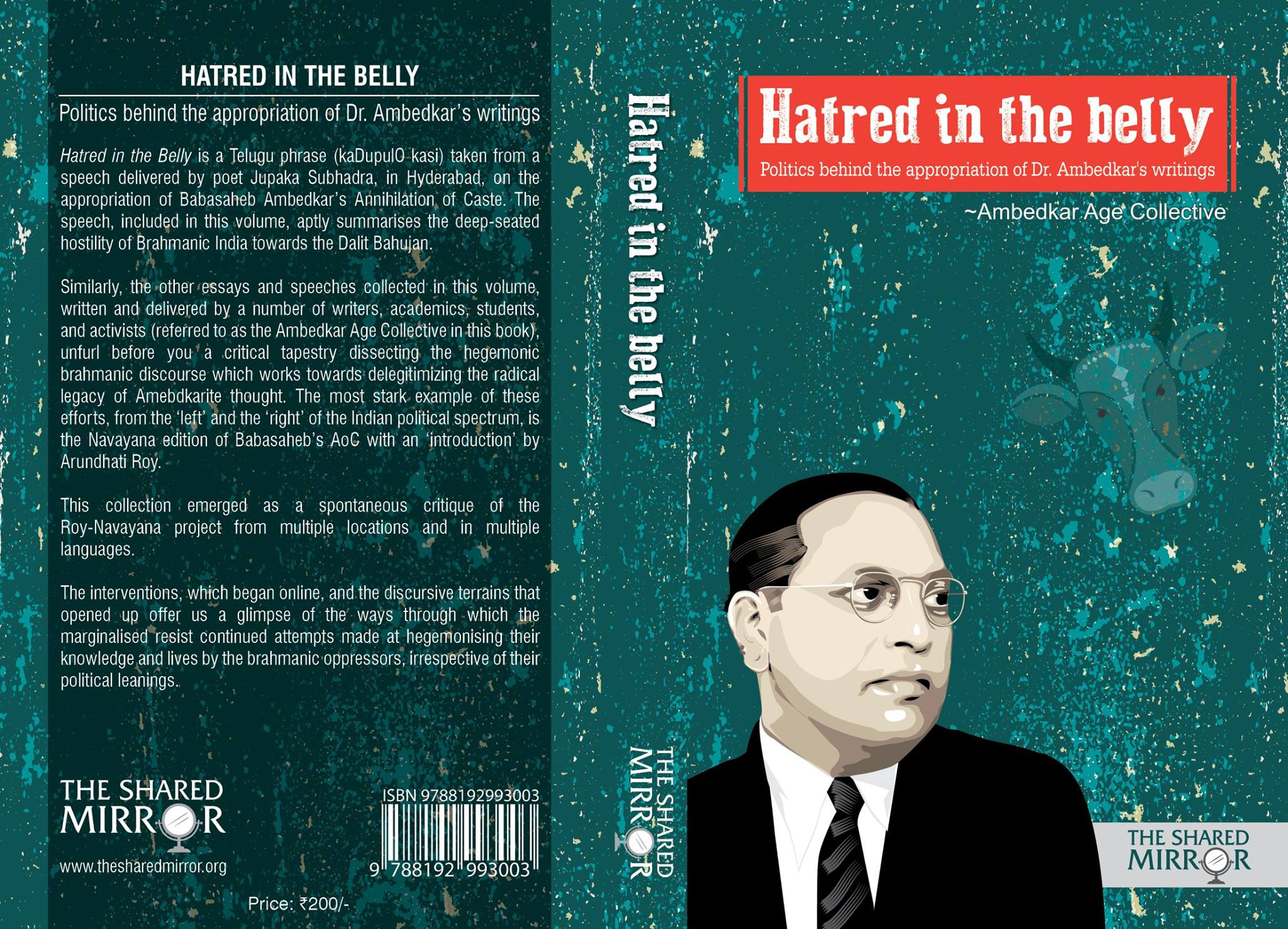
Hatred in the Belly is a Telugu phrase (kaDupulO kasi) taken from a speech delivered by poet Jupaka Subhadra, in Hyderabad, on the appropriation of Babasaheb Ambedkar’s Annihilation of Caste. The speech, included in this volume, aptly summarises the deep-seated hostility of Brahminic India towards the Dalit Bahujan. Similarly, the other essays and speeches collected in this volume, written and delivered by a number of writers, academics, students, and activists (referred to as the Ambedkar Age Collective in this book), unfurl before you a critical tapestry dissecting the hegemonic brahminic discourse which works towards delegitimizing the radical legacy of Amebdkarite thought. The most stark example of these efforts, from the ‘left’ and the ‘right’ of the Indian political spectrum, is the Navayana edition of Babasaheb’s AoC with an ‘introduction’ by Arundhati Roy. The works collected here emerged as spontaneous reactions to the Roy-Navayana project from multiple locations and in multiple languages. The varied interventions, which began online, and the discursive terrains it opened up offer us a glimpse of the ways through which the marginalised resist continued attempts made at hegemonising their knowledge and lives by the brahminic oppressors irrespective of their political leanings. Authors include: Anu Ramdas, Kuffir, Gurinder Azad, Bojja Tharakam Adv. Dr. Suresh Mane, Anoop Kumar, U. Sambashiva Rao, Shakyamuni, Dr Sangeeta Pawar, Sunny Kapicadu, O.K. Santhosh, Dr B. Ravichandran, Dalit Camera: Through Un-Touchable Eyes, Karthik Navayan, Joopaka Subhadra Dr. K Satyanarayana, Vaibhav Wasnik, Nilesh Kumar, Asha Kowtal, Nidhin Shobhana, Gee Imaan Semmalar, Syam Sundar, Murali Shanmugavelan, Praveena Thaali, Dr Karthick RM, Huma Dar, Joby Mathew, James Michael, Akshay Pathak, Vinay Bhat, Yogesh Maitreya, Thongam Bipin, K K Baburaj, Sruthi Herbert, Gaurav Somwanshi, Kadhiravan, Rahul Gaikwad, Joe D’Cruz

Product details

Paperback: 263 pages
Publisher: The Shared Mirror Publishing House; First Edition edition (2015)
Language: English
ISBN-10: 8192993000
ISBN-13: 978-8192993003

Buy the book on Amazon

Source – Round Table India

Goodreads: Hatred in the belly

Ratings, reviews and who is reading Hatred in the belly on GOODREADS.

book cover hib1Hatred in the Belly is a Telugu phrase (kaDupulO kasi) taken from a speech delivered by poet Joopaka Subhadra, in Hyderabad, on the appropriation of Babasaheb Ambedkar’s Annihilation of Caste. The speech, included in this volume, aptly summarises the deep-seated hostility of Brahminic India towards the Dalit Bahujan. Similarly, the other essays and speeches collected in this volume, written and delivered by a number of writers, academics, students, and activists (referred to as the Ambedkar Age Collective in this book), unfurl before you a critical tapestry dissecting the hegemonic brahminic discourse which works towards delegitimizing the radical legacy of Amebdkarite thought. The most stark example of these efforts, from the ‘left’ and the ‘right’ of the Indian political spectrum, is the Navayana edition of Babasaheb’s AoC with an ‘introduction’ by Arundhati Roy. The works collected here emerged as spontaneous reactions to the Roy-Navayana project from multiple locations and in multiple languages. The varied interventions, which began online, and the discursive terrains it opened up offer us a glimpse of the ways through which the marginalised resist continued attempts made at hegemonising their knowledge and lives by the brahminic oppressors irrespective of their political leanings. Authors include: Anu Ramdas, Kuffir, Gurinder Azad, Bojja Tharakam Adv. Dr. Suresh Mane, Anoop Kumar, U. Sambashiva Rao, Shakyamuni, Dr Sangeeta Pawar, Sunny Kapicadu, O.K. Santhosh, Dr B. Ravichandran, Dalit Camera: Through Un-Touchable Eyes, Karthik Navayan, Joopaka Subhadra Dr. K Satyanarayana, Vaibhav Wasnik, Nilesh Kumar, Asha Kowtal, Nidhin Shobhana, Gee Imaan Semmalar, Syam Sundar, Murali Shanmugavelan, Praveena Thaali, Dr Karthick RM, Huma Dar, Joby Mathew, James Michael, Akshay Pathak, Vinay Bhat, Yogesh Maitreya, Thongam Bipin, K K Baburaj, Sruthi Herbert, Gaurav Somwanshi, Kadhiravan, Rahul Gaikwad, Joe D’Cruz

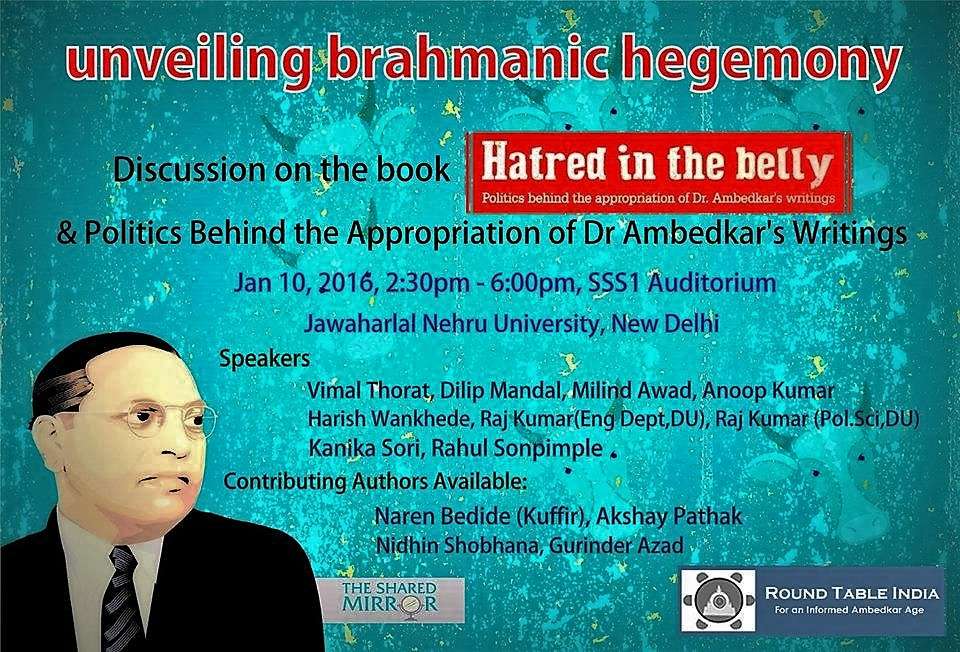
Unveiling Brahmanic Hegemony: A Discussion on ‘Hatred in the belly: Politics behind the appropriation of Dr Ambedkar’s Writings’

Unveiling Brahmanic Hegemony: A Discussion on ‘Hatred in the belly: Politics behind the appropriation of Dr Ambedkar’s Writings’

The Shared Mirror is pleased to invite you for a  discussion on ‘Hatred in the belly: Politics behind the appropriation of Dr Ambedkar’s Writings’ at JNU, New Delhi

Date: 10TH January 2016

Time: 2.30PM To 6.00PM

Place: School of Social Sciences-I Auditorium, JNU, New Delhi

SPEAKERS

VIMAL THORAT, CONVENOR –NCDHR

DR. RAJ KUMAR, DEPT. OF ENGLISH, DU

DR. RAJ KUMAR, DEPT. OF POL. SCI., DU

DR. MILIND EKNATH AWAD, JNU

DR. HARISH S. WANKHEDE, JNU

DILIP MANDAL, FORMER EDITOR, INDIA TODAY

ANOOP KUMAR, TEACHER-ACTIVIST, WARDHA

KANIKA SORI, WRITER & RESEARCHER

RAHUL SONPIMPLE, WRITER & RESEARCHER

NAREN BEDIDE (KUFFIR), EDITOR, RTI EDITOR, RTI

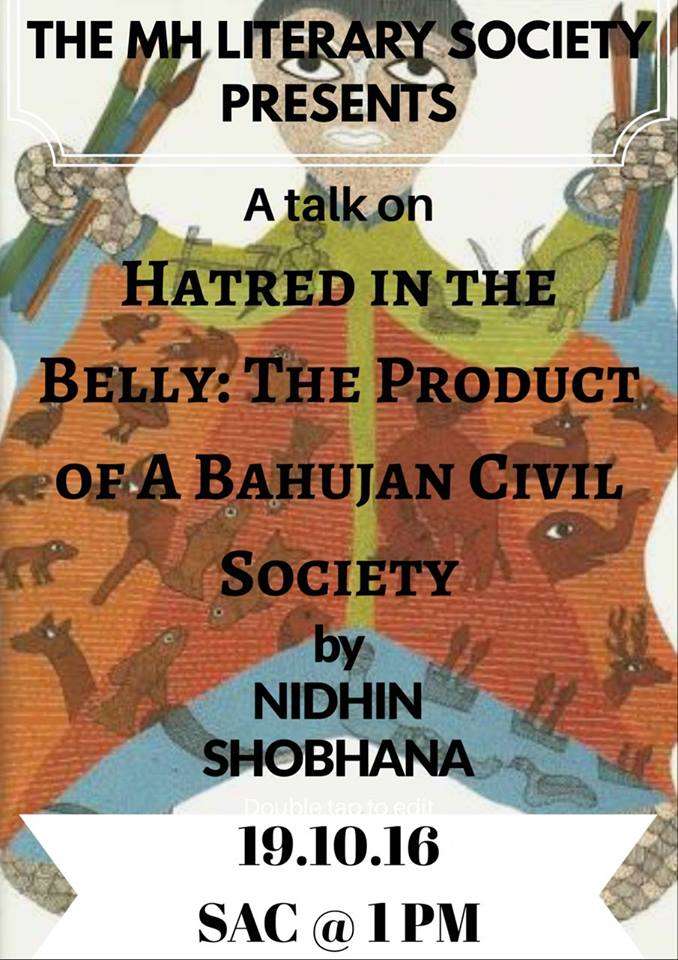
Other contributing authors joining the discussion include, Nidhin Shobhana, Akshay Pathak and Gurinder Azad


delhi_poster